目录
上周和一位刚上班的C#小孩聊天,他苦恼地说:"每次面试都会被问到值类型和引用类型的区别,我总是答得模糊不清。更要命的是,线上系统偶尔出现内存泄漏,但我根本不知道从哪里排查。"
今天这篇文章,我将用最通俗的语言和实战代码,帮你彻底搞懂C#变量类型与内存分配的核心机制,让你在技术面试和实际开发中都能游刃有余。
🔍 问题分析:为什么内存机制如此重要?
在深入解决方案之前,我们先来分析一下,为什么理解变量类型和内存分配如此关键:
- 性能影响:不同的变量类型在内存中的存储和访问方式差异巨大
- 内存泄漏:错误的变量使用方式可能导致内存无法释放
- 面试必考:几乎所有C#技术面试都会涉及这个话题
- 代码质量:深入理解有助于写出更高效、更稳定的代码
💡 解决方案一:深入理解值类型与引用类型
🎯 核心概念解析
C#namespace AppVariableMemory
{
    internal class Program
    {

        static void Main(string[] args)
        {
            // 值类型示例 - 存储在栈上
            int valueType1 = 10;        // 直接存储值
            int valueType2 = valueType1; // 复制值
            valueType2 = 20;            // 修改副本,不影响原值

            Console.WriteLine($"valueType1: {valueType1}");
            Console.WriteLine($"valueType2: {valueType2}");

            // 引用类型示例 - 对象存储在堆上,引用存储在栈上
            Person person1 = new Person { Name = "张三", Age = 25 };
            Person person2 = person1;    // 复制引用,指向同一个对象
            person2.Name = "李四";       // 修改对象属性

            Console.WriteLine($"person1.Name: {person1.Name}");
            Console.WriteLine($"person2.Name: {person2.Name}");

            // 关键差异演示
            DemonstrateMemoryAllocation();
        }

        static void DemonstrateMemoryAllocation()
        {
            // 值类型:每次赋值都创建新的内存空间
            int a = 5;
            int b = a;  // 在栈上创建新的内存位置
            b = 10;     // 只修改b的值,a不受影响

            // 引用类型:多个变量可以指向同一个对象
            var list1 = new List<int> { 1, 2, 3 };
            var list2 = list1;  // list2和list1指向同一个List对象
            list2.Add(4);       // 通过list2修改,list1也能看到变化

            Console.WriteLine($"list1 count: {list1.Count}");
            Console.WriteLine($"list2 count: {list2.Count}");
        }
    }

    // 自定义引用类型
    public class Person
    {
        public string Name { get; set; }
        public int Age { get; set; }
    }
}
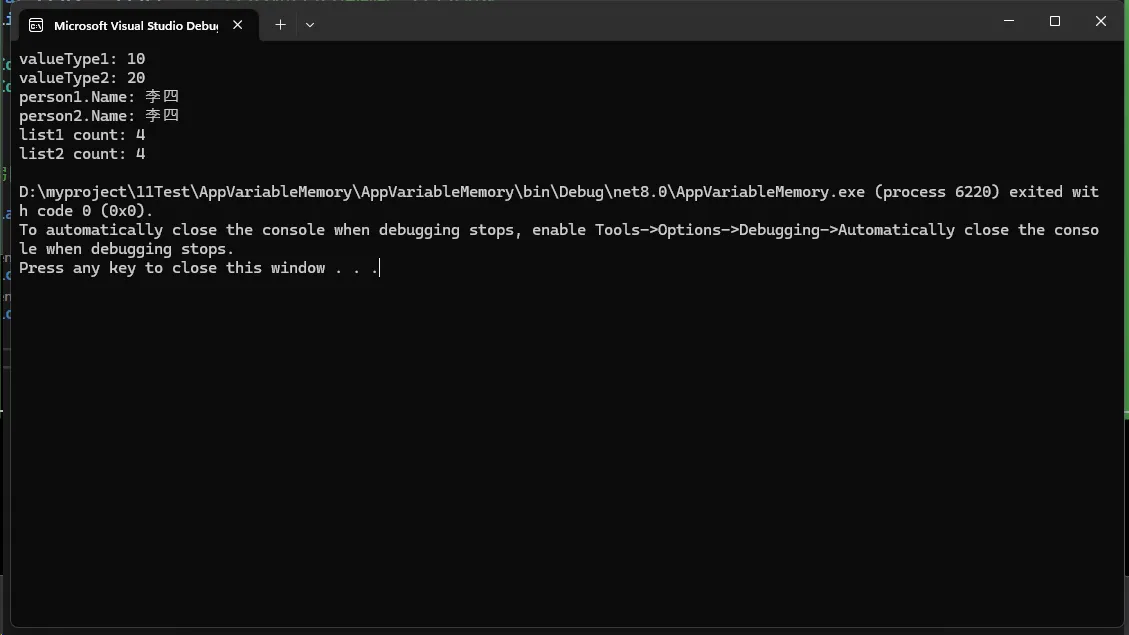
⚠️ 常见坑点提醒:
- 值类型赋值是复制操作,修改副本不影响原值
- 引用类型赋值是复制引用,多个变量指向同一对象
- string虽然是引用类型(这个对于新手最不容易理解),但具有值类型的行为特征(不可变性)
💡 解决方案二:掌握栈和堆的内存分配策略
🏗️ 内存区域详解
C#using System;
using System.Collections.Generic;
using System.Linq;
using System.Text;
using System.Threading.Tasks;

namespace AppVariableMemory
{
   public class MemoryManager
    {
        // 静态字段 - 存储在方法区
        private static int staticCounter = 0;

        // 实例字段 - 存储在堆上(作为对象的一部分)
        private int instanceCounter = 0;

        public void DemonstrateStackAllocation()
        {
            Console.WriteLine("=== 栈内存分配演示 ===");

            // 局部变量 - 存储在栈上,这里可能是不少人忽略的,要是学习C,就清晰多了
            int localInt = 42;              // 栈上分配4字节
            double localDouble = 3.14;      // 栈上分配8字节
            bool localBool = true;          // 栈上分配1字节
            char localChar = 'A';           // 栈上分配2字节

            // 结构体 - 整个结构体存储在栈上
            Point point = new Point(10, 20);

            Console.WriteLine($"栈上变量: {localInt}, {localDouble}, {localBool}, {localChar}");
            Console.WriteLine($"结构体: ({point.X}, {point.Y})");

            // 演示栈的后进先出特性
            DemonstrateStackLifetime();
        }

        public void DemonstrateHeapAllocation()
        {
            Console.WriteLine("\n=== 堆内存分配演示 ===");

            // 对象创建 - 在堆上分配内存
            Person person = new Person("Alice", 30);

            // 数组创建 - 数组对象在堆上
            int[] numbers = new int[5] { 1, 2, 3, 4, 5 };

            // 集合创建 - 集合对象在堆上
            List<string> names = new List<string> { "Tom", "Jerry", "Mickey" };

            // 字符串 - 每个字符串字面量在堆上创建一个对象
            string message = "Hello World";

            Console.WriteLine($"Person对象: {person.Name}, Age: {person.Age}");
            Console.WriteLine($"数组长度: {numbers.Length}");
            Console.WriteLine($"集合元素数: {names.Count}");
            Console.WriteLine($"字符串: {message}");

            // 演示引用的复制
            DemonstrateReferenceSharing(person, numbers);
        }

        private void DemonstrateStackLifetime()
        {
            // 方法开始时,为局部变量分配栈空间
            int methodVariable = 100;

            {
                // 进入代码块,继续在栈上分配
                int blockVariable = 200;
                Console.WriteLine($"代码块内: {blockVariable}");

                // blockVariable在代码块结束时自动释放
            }

            Console.WriteLine($"方法内: {methodVariable}");

            // methodVariable在方法结束时自动释放
        }

        private void DemonstrateReferenceSharing(Person person, int[] array)
        {
            // 引用类型参数传递:传递的是引用的副本
            person.Age = 35;  // 修改原对象
            array[0] = 999;   // 修改原数组

            // 重新赋值:只影响局部引用,不影响原始引用
            person = new Person("Bob", 25);
            array = new int[] { 7, 8, 9 };

            Console.WriteLine($"方法内新对象: {person.Name}");
        }

        public void DemonstrateMemoryPressure()
        {
            Console.WriteLine("\n=== 内存压力测试 ===");

            // 大量对象创建,观察GC行为
            var largeList = new List<byte[]>();

            for (int i = 0; i < 1000; i++)
            {
                // 每次创建1MB的字节数组
                byte[] largeArray = new byte[1024 * 1024];
                largeList.Add(largeArray);

                // 每100次创建后显示内存使用情况
                if (i % 100 == 0)
                {
                    long memoryBefore = GC.GetTotalMemory(false);
                    Console.WriteLine($"创建{i + 1}个对象后,内存使用: {memoryBefore / 1024 / 1024} MB");
                }
            }

            // 强制垃圾回收
            Console.WriteLine("执行垃圾回收...");
            long memoryBeforeGC = GC.GetTotalMemory(false);
            GC.Collect();
            GC.WaitForPendingFinalizers();
            GC.Collect();
            long memoryAfterGC = GC.GetTotalMemory(true);

            Console.WriteLine($"GC前内存: {memoryBeforeGC / 1024 / 1024} MB");
            Console.WriteLine($"GC后内存: {memoryAfterGC / 1024 / 1024} MB");
            Console.WriteLine($"释放内存: {(memoryBeforeGC - memoryAfterGC) / 1024 / 1024} MB");
        }
    }

    // 值类型 - 结构体
    public struct Point
    {
        public int X { get; }
        public int Y { get; }

        public Point(int x, int y)
        {
            X = x;
            Y = y;
        }
    }

    // 引用类型 - 类
    public class Person
    {
        public string Name { get; set; }
        public int Age { get; set; }

        public Person(string name, int age)
        {
            Name = name;
            Age = age;
        }
    }
}

🎯 实际应用场景:
- 高频调用方法:优先使用值类型,避免频繁的堆分配
- 大型数据结构:使用引用类型,避免大量数据的栈复制
- 性能敏感代码:合理选择类型可以显著提升性能
💡 解决方案三:掌握装箱和拆箱机制
📦 装箱拆箱深度解析
C#using System;
using System.Collections;
using System.Collections.Generic;
using System.Diagnostics;
using System.Linq;
using System.Text;
using System.Threading.Tasks;

namespace AppVariableMemory
{
   public class BoxingManager
    {
        public void DemonstrateBoxingUnboxing()
        {
            Console.WriteLine("=== 装箱拆箱演示 ===");

            // 装箱(Boxing):值类型 → 引用类型
            int value = 42;
            object boxedValue = value;  // 隐式装箱,在堆上创建新对象

            Console.WriteLine($"原始值: {value}");
            Console.WriteLine($"装箱后: {boxedValue}");
            Console.WriteLine($"类型对比: {value.GetType()} vs {boxedValue.GetType()}");

            // 拆箱(Unboxing):引用类型 → 值类型
            int unboxedValue = (int)boxedValue;  // 显式拆箱

            Console.WriteLine($"拆箱后: {unboxedValue}");

            // 装箱后的对象是独立的
            value = 100;
            Console.WriteLine($"修改原值后: value={value}, boxedValue={boxedValue}");

            // 演示性能影响
            DemonstratePerformanceImpact();
        }

        public void DemonstratePerformanceImpact()
        {
            Console.WriteLine("\n=== 装箱拆箱性能影响 ===");

            const int iterations = 1000000;
            Stopwatch sw = new Stopwatch();

            // 测试1:无装箱操作
            sw.Start();
            for (int i = 0; i < iterations; i++)
            {
                int temp = i;
                temp = temp + 1;  // 纯值类型操作
            }
            sw.Stop();
            long withoutBoxing = sw.ElapsedMilliseconds;
            Console.WriteLine($"无装箱操作耗时: {withoutBoxing} ms");

            // 测试2:频繁装箱操作
            sw.Restart();
            for (int i = 0; i < iterations; i++)
            {
                object boxed = i;      // 装箱
                int unboxed = (int)boxed;  // 拆箱
            }
            sw.Stop();
            long withBoxing = sw.ElapsedMilliseconds;
            Console.WriteLine($"频繁装箱操作耗时: {withBoxing} ms");
            Console.WriteLine($"性能差异: {(double)withBoxing / withoutBoxing:F2}x");

            // 测试3:ArrayList vs List<T>
            CompareCollectionPerformance();
        }

        private void CompareCollectionPerformance()
        {
            Console.WriteLine("\n=== 集合装箱性能对比 ===");

            const int count = 100000;
            Stopwatch sw = new Stopwatch();

            // ArrayList(会装箱)
            sw.Start();
            ArrayList arrayList = new ArrayList(count);
            for (int i = 0; i < count; i++)
            {
                arrayList.Add(i);  // 装箱:int → object
            }

            int sum1 = 0;
            foreach (object item in arrayList)
            {
                sum1 += (int)item;  // 拆箱:object → int
            }
            sw.Stop();
            long arrayListTime = sw.ElapsedMilliseconds;

            // List<int>(无装箱)
            sw.Restart();
            List<int> list = new List<int>(count);
            for (int i = 0; i < count; i++)
            {
                list.Add(i);  // 无装箱,直接存储
            }

            int sum2 = 0;
            foreach (int item in list)
            {
                sum2 += item;  // 无拆箱,直接使用
            }
            sw.Stop();
            long listTime = sw.ElapsedMilliseconds;

            Console.WriteLine($"ArrayList耗时: {arrayListTime} ms (sum: {sum1})");
            Console.WriteLine($"List<int>耗时: {listTime} ms (sum: {sum2})");
            Console.WriteLine($"泛型集合性能提升: {(double)arrayListTime / listTime:F2}x");
        }

        public void DemonstrateCommonBoxingScenarios()
        {
            Console.WriteLine("\n=== 常见装箱场景 ===");

            // 场景1:字符串格式化
            int number = 42;
            string result1 = string.Format("Number: {0}", number);  // 装箱
            string result2 = $"Number: {number}";                   // C# 6.0+,编译器优化

            Console.WriteLine($"格式化结果: {result1}");

            // 场景2:方法参数
            ProcessObject(number);  // 隐式装箱

            // 场景3:接口转换
            IComparable comparable = number;  // 装箱
            int comparisonResult = comparable.CompareTo(50);
            Console.WriteLine($"比较结果: {comparisonResult}");

            // 场景4:集合操作
            var hashSet = new HashSet<object>();
            hashSet.Add(1);      // 装箱
            hashSet.Add(2.5);    // 装箱
            hashSet.Add("text"); // 字符串,无装箱

            Console.WriteLine($"HashSet元素数量: {hashSet.Count}");
        }

        private void ProcessObject(object obj)
        {
            Console.WriteLine($"接收到对象: {obj}, 类型: {obj.GetType()}");
        }

        public void DemonstrateOptimizationTechniques()
        {
            Console.WriteLine("\n=== 装箱优化技巧 ===");

            // 技巧1:使用泛型避免装箱
            Console.WriteLine("1. 使用泛型集合:");
            var genericList = new List<int> { 1, 2, 3, 4, 5 };
            Console.WriteLine($"泛型集合元素: {string.Join(", ", genericList)}");

            // 技巧2:ToString()方法避免格式化装箱
            Console.WriteLine("2. 使用ToString():");
            int value = 123;
            string formatted = "Value: " + value.ToString();  // 避免装箱
            Console.WriteLine(formatted);

            // 技巧3:结构体实现接口时的优化
            Console.WriteLine("3. 结构体接口实现:");
            var point = new OptimizedPoint(10, 20);
            // 直接调用不会装箱
            Console.WriteLine($"Point: {point}");

            // 但是接口引用会装箱
            IFormattable formattable = point;  // 装箱
            Console.WriteLine($"Through interface: {formattable}");
        }
    }

    // 优化的结构体实现
    public struct OptimizedPoint : IFormattable
    {
        public int X { get; }
        public int Y { get; }

        public OptimizedPoint(int x, int y)
        {
            X = x;
            Y = y;
        }

        public override string ToString()
        {
            return $"({X}, {Y})";
        }

        public string ToString(string format, IFormatProvider formatProvider)
        {
            return ToString();
        }
    }
}
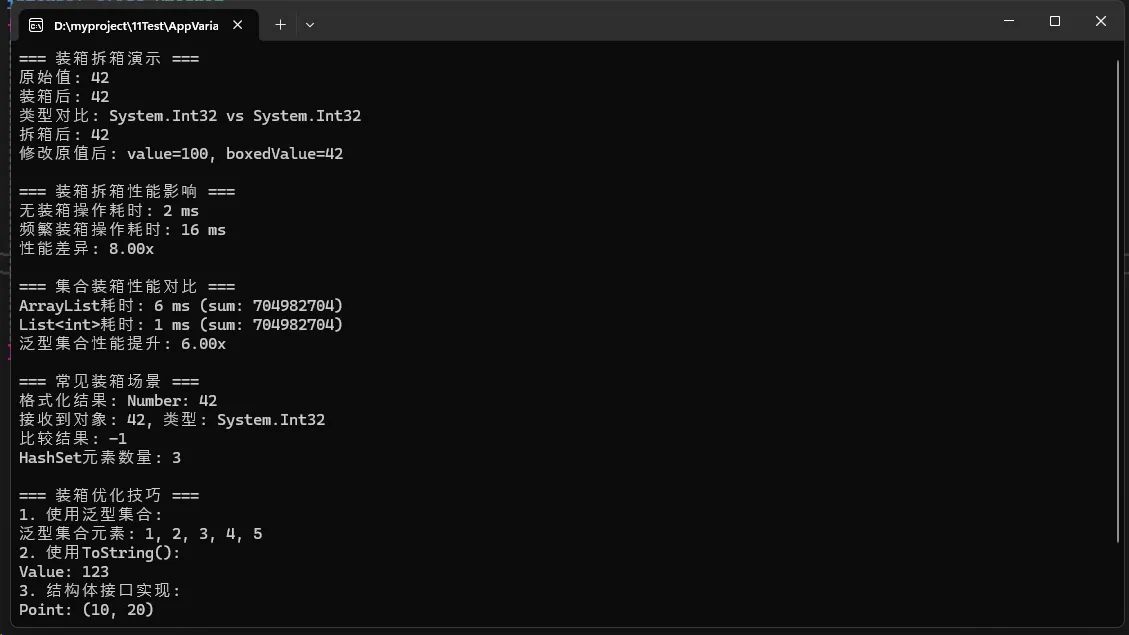
⚠️ 性能优化要点:
- 避免在循环中频繁装箱拆箱
- 优先使用泛型集合(List而不是ArrayList),记得ArrayList这个是在.Net 刚出时兴奋的不行。
- 字符串格式化时使用插值表达式或ToString()
💡 解决方案四:内存管理与垃圾回收优化
🗑️ GC机制深度优化
C#using System;
using System.Collections.Generic;
using System.Linq;
using System.Text;
using System.Threading.Tasks;

namespace AppVariableMemory
{
    public class MemoryOptimizer
    {
        public void DemonstrateGCGenerations()
        {
            Console.WriteLine("=== 垃圾回收代数演示 ===");

            // 显示当前GC信息
            DisplayGCInfo("程序启动时");

            // 创建大量短生命周期对象(第0代)
            CreateShortLivedObjects();
            DisplayGCInfo("创建短生命周期对象后");

            // 创建中等生命周期对象(可能进入第1代)
            var mediumLivedObjects = CreateMediumLivedObjects();
            GC.Collect();  // 强制回收,观察代数变化
            DisplayGCInfo("创建中等生命周期对象并GC后");

            // 创建长生命周期对象(可能进入第2代)
            var longLivedObjects = CreateLongLivedObjects();

            // 多次GC观察对象代数提升
            for (int i = 0; i < 3; i++)
            {
                GC.Collect();
                GC.WaitForPendingFinalizers();
                DisplayGCInfo($"第{i + 1}次完整GC后");
            }

            // 保持引用避免被回收
            Console.WriteLine($"保持引用: {mediumLivedObjects.Count} + {longLivedObjects.Count}");
        }

        private void CreateShortLivedObjects()
        {
            // 创建大量临时对象
            for (int i = 0; i < 10000; i++)
            {
                var temp = new byte[1024];  // 1KB临时数组
                var tempString = $"临时字符串_{i}";
                var tempList = new List<int> { i, i + 1, i + 2 };
            }
            // 方法结束后,这些对象成为垃圾
        }

        private List<DataObject> CreateMediumLivedObjects()
        {
            var objects = new List<DataObject>();
            for (int i = 0; i < 1000; i++)
            {
                objects.Add(new DataObject($"中等对象_{i}", new byte[1024]));
            }
            return objects;
        }

        private List<LargeDataObject> CreateLongLivedObjects()
        {
            var objects = new List<LargeDataObject>();
            for (int i = 0; i < 100; i++)
            {
                objects.Add(new LargeDataObject($"长期对象_{i}", new byte[10240]));
            }
            return objects;
        }

        private void DisplayGCInfo(string stage)
        {
            Console.WriteLine($"\n--- {stage} ---");
            Console.WriteLine($"第0代回收次数: {GC.CollectionCount(0)}");
            Console.WriteLine($"第1代回收次数: {GC.CollectionCount(1)}");
            Console.WriteLine($"第2代回收次数: {GC.CollectionCount(2)}");
            Console.WriteLine($"当前内存使用: {GC.GetTotalMemory(false) / 1024} KB");
        }

        public void DemonstrateMemoryLeakPrevention()
        {
            Console.WriteLine("\n=== 内存泄漏防范演示 ===");

            // 场景1:事件订阅泄漏
            Console.WriteLine("1. 事件订阅内存泄漏:");
            DemonstrateEventLeakPrevention();

            // 场景2:大对象处理
            Console.WriteLine("\n2. 大对象内存管理:");
            DemonstrateLargeObjectHandling();

            // 场景3:缓存管理
            Console.WriteLine("\n3. 缓存内存管理:");
            DemonstrateCacheManagement();
        }

        private void DemonstrateEventLeakPrevention()
        {
            var publisher = new EventPublisher();
            var subscriber1 = new EventSubscriber("订阅者1");
            var subscriber2 = new EventSubscriber("订阅者2");

            // 订阅事件
            publisher.SomeEvent += subscriber1.HandleEvent;
            publisher.SomeEvent += subscriber2.HandleEvent;

            // 触发事件
            publisher.TriggerEvent("测试事件");

            // 重要:取消订阅防止内存泄漏
            publisher.SomeEvent -= subscriber1.HandleEvent;
            publisher.SomeEvent -= subscriber2.HandleEvent;

            Console.WriteLine("事件订阅已清理,防止内存泄漏");

            // 使用WeakReference的高级技巧
            DemonstrateWeakReference();
        }

        private void DemonstrateWeakReference()
        {
            Console.WriteLine("\n弱引用演示:");

            // 创建对象并建立弱引用
            var strongRef = new LargeDataObject("强引用对象", new byte[1024]);
            var weakRef = new WeakReference(strongRef);

            Console.WriteLine($"弱引用目标存在: {weakRef.IsAlive}");
            Console.WriteLine($"通过弱引用访问: {((LargeDataObject)weakRef.Target)?.Name}");

            // 移除强引用
            strongRef = null;

            // 强制垃圾回收
            GC.Collect();
            GC.WaitForPendingFinalizers();

            Console.WriteLine($"GC后弱引用目标存在: {weakRef.IsAlive}");
            if (weakRef.IsAlive)
            {
                Console.WriteLine($"对象仍然存在: {((LargeDataObject)weakRef.Target)?.Name}");
            }
            else
            {
                Console.WriteLine("对象已被垃圾回收");
            }
        }

        private void DemonstrateLargeObjectHandling()
        {
            // 大对象堆(LOH)演示
            Console.WriteLine("创建大对象(>85KB):");

            long memoryBefore = GC.GetTotalMemory(false);

            // 创建大对象(>85KB会进入LOH)
            var largeArray = new byte[100 * 1024]; // 100KB

            long memoryAfter = GC.GetTotalMemory(false);

            Console.WriteLine($"大对象创建前内存: {memoryBefore / 1024} KB");
            Console.WriteLine($"大对象创建后内存: {memoryAfter / 1024} KB");
            Console.WriteLine($"内存增长: {(memoryAfter - memoryBefore) / 1024} KB");

            // 大对象最佳实践:及时释放
            largeArray = null;
            GC.Collect();

            long memoryAfterGC = GC.GetTotalMemory(true);
            Console.WriteLine($"释放后内存: {memoryAfterGC / 1024} KB");
        }

        private void DemonstrateCacheManagement()
        {
            var cache = new MemoryEfficientCache<string, DataObject>();

            // 添加缓存项
            for (int i = 0; i < 1000; i++)
            {
                var key = $"key_{i}";
                var value = new DataObject($"缓存对象_{i}", new byte[512]);
                cache.Set(key, value);
            }

            Console.WriteLine($"缓存项数量: {cache.Count}");

            // 模拟内存压力,触发缓存清理
            GC.Collect();
            Console.WriteLine($"GC后缓存项数量: {cache.Count}");

            // 访问一些项以防止被清理
            for (int i = 0; i < 100; i++)
            {
                cache.Get($"key_{i}");
            }

            GC.Collect();
            Console.WriteLine($"访问后GC缓存项数量: {cache.Count}");
        }
    }

    // 事件发布者
    public class EventPublisher
    {
        public event Action<string> SomeEvent;

        public void TriggerEvent(string message)
        {
            SomeEvent?.Invoke(message);
        }
    }

    // 事件订阅者
    public class EventSubscriber
    {
        private string name;

        public EventSubscriber(string name)
        {
            this.name = name;
        }

        public void HandleEvent(string message)
        {
            Console.WriteLine($"{name} 收到事件: {message}");
        }
    }

    // 数据对象
    public class DataObject
    {
        public string Name { get; set; }
        public byte[] Data { get; set; }

        public DataObject(string name, byte[] data)
        {
            Name = name;
            Data = data;
        }
    }

    // 大数据对象
    public class LargeDataObject
    {
        public string Name { get; set; }
        public byte[] LargeData { get; set; }

        public LargeDataObject(string name, byte[] data)
        {
            Name = name;
            LargeData = data;
        }
    }

    // 内存高效的缓存实现
    public class MemoryEfficientCache<TKey, TValue> where TValue : class
    {
        private readonly Dictionary<TKey, WeakReference> cache = new Dictionary<TKey, WeakReference>();

        public void Set(TKey key, TValue value)
        {
            cache[key] = new WeakReference(value);
        }

        public TValue Get(TKey key)
        {
            if (cache.TryGetValue(key, out var weakRef) && weakRef.IsAlive)
            {
                return (TValue)weakRef.Target;
            }

            // 清理死引用
            if (weakRef != null && !weakRef.IsAlive)
            {
                cache.Remove(key);
            }

            return null;
        }

        public int Count
        {
            get
            {
                // 清理死引用并返回活跃数量
                var deadKeys = new List<TKey>();
                foreach (var kvp in cache)
                {
                    if (!kvp.Value.IsAlive)
                    {
                        deadKeys.Add(kvp.Key);
                    }
                }

                foreach (var key in deadKeys)
                {
                    cache.Remove(key);
                }

                return cache.Count;
            }
        }
    }
}

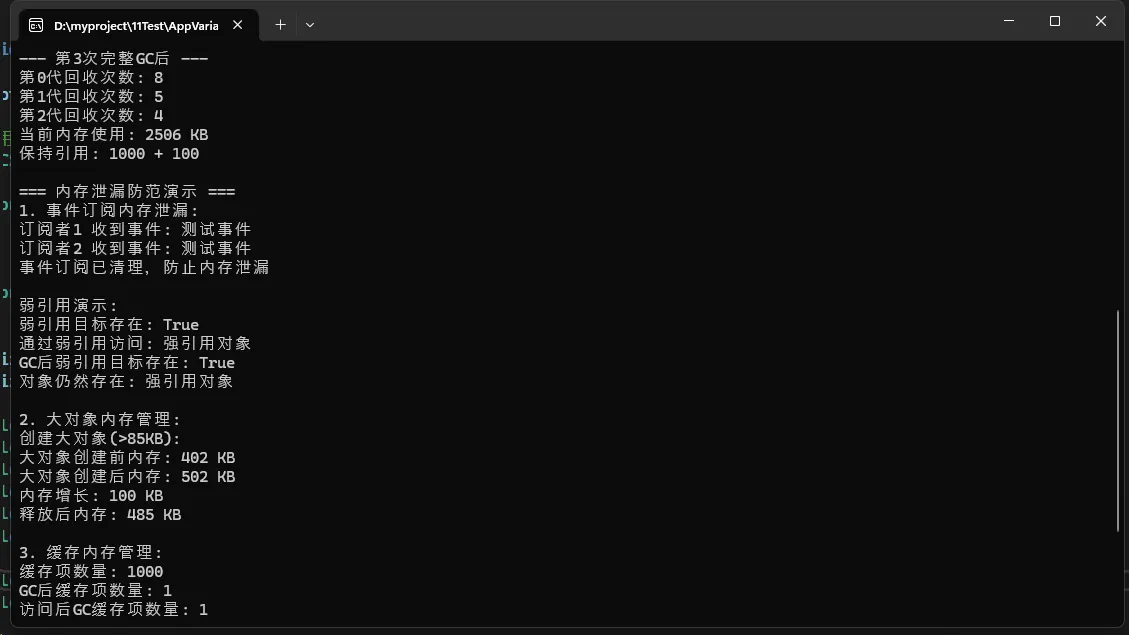
🎯 内存优化核心要点:
- 理解GC代数机制,避免长生命周期对象引用短生命周期对象
- 使用WeakReference处理缓存场景
- 及时释放事件订阅和资源引用
- 监控大对象堆的使用情况
💡 解决方案五:实战性能监控与调优
📊 性能监控工具箱
C#using System;
using System.Collections.Concurrent;
using System.Collections.Generic;
using System.Diagnostics;
using System.Linq;
using System.Text;
using System.Threading.Tasks;

namespace AppVariableMemory
{
    class PerformanceAnalyzer
    {
        public void RunComprehensiveAnalysis()
        {
            Console.WriteLine("=== C# 内存性能综合分析 ===");

            // 1. 基础性能指标监控
            MonitorBasicMetrics();

            // 2. 内存分配模式分析
            AnalyzeAllocationPatterns();

            // 3. GC压力测试
            StressTestGarbageCollection();

            // 4. 实战优化对比
            CompareOptimizationStrategies();
        }

        private void MonitorBasicMetrics()
        {
            Console.WriteLine("\n--- 基础性能指标监控 ---");

            var process = Process.GetCurrentProcess();

            Console.WriteLine($"进程ID: {process.Id}");
            Console.WriteLine($"工作集内存: {process.WorkingSet64 / 1024 / 1024} MB");
            Console.WriteLine($"私有内存: {process.PrivateMemorySize64 / 1024 / 1024} MB");
            Console.WriteLine($"虚拟内存: {process.VirtualMemorySize64 / 1024 / 1024} MB");
            Console.WriteLine($"GC管理内存: {GC.GetTotalMemory(false) / 1024 / 1024} MB");

            // CPU使用率监控
            var startTime = DateTime.UtcNow;
            var startCpuUsage = process.TotalProcessorTime;

            // 执行一些CPU密集操作
            Thread.Sleep(1000);

            var endTime = DateTime.UtcNow;
            var endCpuUsage = process.TotalProcessorTime;

            var cpuUsedMs = (endCpuUsage - startCpuUsage).TotalMilliseconds;
            var totalMsPassed = (endTime - startTime).TotalMilliseconds;
            var cpuUsageTotal = cpuUsedMs / (Environment.ProcessorCount * totalMsPassed);

            Console.WriteLine($"CPU使用率: {cpuUsageTotal:P}");
        }

        private void AnalyzeAllocationPatterns()
        {
            Console.WriteLine("\n--- 内存分配模式分析 ---");

            // 模式1:频繁小对象分配
            AnalyzeSmallObjectPattern();

            // 模式2:大对象分配
            AnalyzeLargeObjectPattern();

            // 模式3:集合扩容模式
            AnalyzeCollectionGrowthPattern();
        }

        private void AnalyzeSmallObjectPattern()
        {
            Console.WriteLine("\n小对象分配模式:");

            var sw = Stopwatch.StartNew();
            long memoryBefore = GC.GetTotalMemory(true);

            // 创建大量小对象
            var objects = new List<SmallObject>();
            for (int i = 0; i < 100000; i++)
            {
                objects.Add(new SmallObject { Id = i, Name = $"Object_{i}" });
            }

            sw.Stop();
            long memoryAfter = GC.GetTotalMemory(false);

            Console.WriteLine($"创建10万个小对象耗时: {sw.ElapsedMilliseconds} ms");
            Console.WriteLine($"内存增长: {(memoryAfter - memoryBefore) / 1024} KB");
            Console.WriteLine($"平均每对象内存: {(memoryAfter - memoryBefore) / objects.Count} bytes");

            // 分析GC影响
            int gen0Before = GC.CollectionCount(0);
            int gen1Before = GC.CollectionCount(1);

            // 触发更多分配
            for (int i = 0; i < 50000; i++)
            {
                objects.Add(new SmallObject { Id = i + 100000, Name = $"Extra_{i}" });
            }

            int gen0After = GC.CollectionCount(0);
            int gen1After = GC.CollectionCount(1);

            Console.WriteLine($"额外分配触发GC - 第0代: {gen0After - gen0Before}次, 第1代: {gen1After - gen1Before}次");
        }

        private void AnalyzeLargeObjectPattern()
        {
            Console.WriteLine("\n大对象分配模式:");

            var sw = Stopwatch.StartNew();
            long memoryBefore = GC.GetTotalMemory(true);

            // 创建大对象(进入LOH)
            var largeObjects = new List<byte[]>();
            for (int i = 0; i < 100; i++)
            {
                largeObjects.Add(new byte[100 * 1024]); // 100KB each
            }

            sw.Stop();
            long memoryAfter = GC.GetTotalMemory(false);

            Console.WriteLine($"创建100个大对象(100KB)耗时: {sw.ElapsedMilliseconds} ms");
            Console.WriteLine($"内存增长: {(memoryAfter - memoryBefore) / 1024} KB");

            // 检查是否触发了第2代GC
            int gen2Count = GC.CollectionCount(2);

            // 创建更多大对象
            for (int i = 0; i < 50; i++)
            {
                largeObjects.Add(new byte[200 * 1024]); // 200KB each
            }

            int gen2CountAfter = GC.CollectionCount(2);
            Console.WriteLine($"大对象分配触发第2代GC: {gen2CountAfter - gen2Count}次");
        }

        private void AnalyzeCollectionGrowthPattern()
        {
            Console.WriteLine("\n集合扩容模式分析:");

            // 低效方式:未预设容量
            var sw = Stopwatch.StartNew();
            var inefficientList = new List<int>();
            for (int i = 0; i < 100000; i++)
            {
                inefficientList.Add(i);
            }
            sw.Stop();
            long inefficientTime = sw.ElapsedMilliseconds;

            // 高效方式:预设容量
            sw.Restart();
            var efficientList = new List<int>(100000);
            for (int i = 0; i < 100000; i++)
            {
                efficientList.Add(i);
            }
            sw.Stop();
            long efficientTime = sw.ElapsedMilliseconds;

            Console.WriteLine($"未预设容量耗时: {inefficientTime} ms");
            Console.WriteLine($"预设容量耗时: {efficientTime} ms");
            Console.WriteLine($"性能提升: {(double)inefficientTime / efficientTime:F2}x");
        }

        private void StressTestGarbageCollection()
        {
            Console.WriteLine("\n--- GC压力测试 ---");

            var sw = Stopwatch.StartNew();

            // 记录初始GC统计
            var initialStats = new GCStats();

            // 执行内存密集操作
            var results = Parallel.For(0, Environment.ProcessorCount, i =>
            {
                var localObjects = new List<object>();
                for (int j = 0; j < 50000; j++)
                {
                    localObjects.Add(new { Index = j, Data = new byte[1024] });

                    // 偶尔清理一部分
                    if (j % 1000 == 0)
                    {
                        localObjects.Clear();
                    }
                }
            });

            sw.Stop();

            // 记录最终GC统计
            var finalStats = new GCStats();

            Console.WriteLine($"压力测试耗时: {sw.ElapsedMilliseconds} ms");
            Console.WriteLine($"第0代GC次数: {finalStats.Gen0Count - initialStats.Gen0Count}");
            Console.WriteLine($"第1代GC次数: {finalStats.Gen1Count - initialStats.Gen1Count}");
            Console.WriteLine($"第2代GC次数: {finalStats.Gen2Count - initialStats.Gen2Count}");
            Console.WriteLine($"内存使用峰值: {finalStats.TotalMemory / 1024 / 1024} MB");
        }

        private void CompareOptimizationStrategies()
        {
            Console.WriteLine("\n--- 优化策略对比 ---");

            // 策略1:对象池 vs 频繁创建
            CompareObjectPooling();

            // 策略2:结构体 vs 类
            CompareStructVsClass();

            // 策略3:StringBuilder vs 字符串拼接
            CompareStringBuilding();
        }

        private void CompareObjectPooling()
        {
            Console.WriteLine("\n对象池优化对比:");

            const int operations = 100000;

            // 频繁创建对象
            var sw = Stopwatch.StartNew();
            for (int i = 0; i < operations; i++)
            {
                var obj = new ReusableObject();
                obj.Process(i);
            }
            sw.Stop();
            long withoutPooling = sw.ElapsedMilliseconds;

            // 使用对象池
            var pool = new SimpleObjectPool<ReusableObject>(() => new ReusableObject());
            sw.Restart();
            for (int i = 0; i < operations; i++)
            {
                var obj = pool.Get();
                obj.Process(i);
                pool.Return(obj);
            }
            sw.Stop();
            long withPooling = sw.ElapsedMilliseconds;

            Console.WriteLine($"频繁创建对象: {withoutPooling} ms");
            Console.WriteLine($"使用对象池: {withPooling} ms");
            Console.WriteLine($"性能提升: {(double)withoutPooling / withPooling:F2}x");
        }

        private void CompareStructVsClass()
        {
            Console.WriteLine("\n结构体vs类性能对比:");

            const int count = 1000000;

            // 使用结构体
            var sw = Stopwatch.StartNew();
            var structArray = new PointStruct[count];
            for (int i = 0; i < count; i++)
            {
                structArray[i] = new PointStruct(i, i + 1);
            }
            sw.Stop();
            long structTime = sw.ElapsedMilliseconds;

            // 使用类
            sw.Restart();
            var classArray = new PointClass[count];
            for (int i = 0; i < count; i++)
            {
                classArray[i] = new PointClass(i, i + 1);
            }
            sw.Stop();
            long classTime = sw.ElapsedMilliseconds;

            Console.WriteLine($"结构体数组创建: {structTime} ms");
            Console.WriteLine($"类数组创建: {classTime} ms");
            Console.WriteLine($"结构体性能优势: {(double)classTime / structTime:F2}x");
        }

        private void CompareStringBuilding()
        {
            Console.WriteLine("\n字符串构建性能对比:");

            const int iterations = 10000;

            // 字符串拼接
            var sw = Stopwatch.StartNew();
            string result1 = "";
            for (int i = 0; i < iterations; i++)
            {
                result1 += $"Item_{i}_";
            }
            sw.Stop();
            long concatenationTime = sw.ElapsedMilliseconds;

            // StringBuilder
            sw.Restart();
            var sb = new System.Text.StringBuilder();
            for (int i = 0; i < iterations; i++)
            {
                sb.Append($"Item_{i}_");
            }
            string result2 = sb.ToString();
            sw.Stop();
            long stringBuilderTime = sw.ElapsedMilliseconds;

            Console.WriteLine($"字符串拼接: {concatenationTime} ms");
            Console.WriteLine($"StringBuilder: {stringBuilderTime} ms");
            Console.WriteLine($"StringBuilder性能优势: {(double)concatenationTime / stringBuilderTime:F2}x");
        }
    }

    // 辅助类定义
    public class SmallObject
    {
        public int Id { get; set; }
        public string Name { get; set; }
    }

    public class ReusableObject
    {
        public int Value { get; set; }

        public void Process(int input)
        {
            Value = input * 2;
        }

        public void Reset()
        {
            Value = 0;
        }
    }

    public struct PointStruct
    {
        public int X { get; }
        public int Y { get; }

        public PointStruct(int x, int y)
        {
            X = x;
            Y = y;
        }
    }

    public class PointClass
    {
        public int X { get; }
        public int Y { get; }

        public PointClass(int x, int y)
        {
            X = x;
            Y = y;
        }
    }

    public class GCStats
    {
        public int Gen0Count { get; }
        public int Gen1Count { get; }
        public int Gen2Count { get; }
        public long TotalMemory { get; }

        public GCStats()
        {
            Gen0Count = GC.CollectionCount(0);
            Gen1Count = GC.CollectionCount(1);
            Gen2Count = GC.CollectionCount(2);
            TotalMemory = GC.GetTotalMemory(false);
        }
    }

    // 简单对象池实现
    public class SimpleObjectPool<T> where T : class
    {
        private readonly ConcurrentQueue<T> objects = new ConcurrentQueue<T>();
        private readonly Func<T> objectGenerator;

        public SimpleObjectPool(Func<T> objectGenerator)
        {
            this.objectGenerator = objectGenerator;
        }

        public T Get()
        {
            if (objects.TryDequeue(out T item))
            {
                return item;
            }
            return objectGenerator();
        }

        public void Return(T item)
        {
            if (item is ReusableObject reusable)
            {
                reusable.Reset();
            }
            objects.Enqueue(item);
        }
    }
}
🎯 总结回顾
通过本文的深入学习,我们掌握了C#变量类型与内存分配的核心机制:
🔑 三个关键要点
- 内存分配机制:深入理解栈和堆的区别,值类型和引用类型的存储方式
- 性能优化策略:避免装箱拆箱,合理使用泛型,优化GC压力
- 实战监控技巧:掌握内存监控工具,建立性能分析思维
💡 实用技术要点
- 优先使用值类型处理简单数据,避免不必要的堆分配
- 使用泛型集合替代非泛型集合,减少装箱开销
- 合理管理对象生命周期,及时释放不需要的引用
- 使用性能分析工具定位和解决内存问题
觉得这篇文章对你有帮助吗?
🤔 互动问题:
- 你在实际项目中遇到过哪些内存相关的性能问题?
- 你最常用的内存优化技巧是什么?
欢迎在评论区分享你的经验和问题!如果觉得内容有价值,请转发给更多需要的同行 👨💻👩💻
本文作者:技术老小子
本文链接:
版权声明:本博客所有文章除特别声明外,均采用 BY-NC-SA 许可协议。转载请注明出处!
目录