
Press Ctrl+ and K to search
目录
你是否在WPF开发中遇到过这样的困惑:为什么有些属性支持数据绑定,而有些却不行?为什么WPF控件的属性看起来如此"神奇",能够自动响应变化?这背后的秘密就在于WPF的依赖属性系统。
作为WPF的核心特性之一,依赖属性(Dependency Property)与传统的CLR属性有着本质的不同。理解这两者的区别,不仅能帮你解决数据绑定、样式设置等常见问题,更能让你的WPF应用程序性能更优、功能更强大。
本文将通过实战代码和深度分析,带你彻底搞懂依赖属性系统的工作原理与应用场景。
🔍 问题分析:为什么需要依赖属性?
传统CLR属性的局限性
传统的C#属性本质上是对字段的封装,存在以下限制:
- 无法支持数据绑定:WPF的双向绑定机制需要属性具备变化通知能力
- 缺乏值优先级:无法处理样式、模板、继承等多种值来源的优先级
- 内存占用大:每个对象都需要存储所有属性的值
- 缺乏元数据支持:无法提供验证、强制转换等扩展功能
WPF的解决方案:依赖属性系统
依赖属性通过以下机制解决了这些问题:
- 属性系统:统一管理属性值的存储和获取
- 值优先级:支持本地值、样式、模板等多层级值源
- 变化通知:内置PropertyChanged机制
- 内存优化:稀疏存储,只存储被设置的属性值
💡 核心区别深度解析
🔥 1. 定义方式的根本不同
传统CLR属性定义:
C#public class TraditionalControl : Control
{
    private string _title;

    public string Title
    {
        get { return _title; }
        set
        {
            _title = value;
            // 需要手动触发PropertyChanged
        }
    }
}
依赖属性定义:
C#public class ModernControl : Control
{
    // 1. 注册依赖属性
    public static readonly DependencyProperty TitleProperty =
        DependencyProperty.Register(
            nameof(Title),                    // 属性名
            typeof(string),                   // 属性类型
            typeof(ModernControl),           // 所有者类型
            new PropertyMetadata(            // 元数据
                string.Empty,               // 默认值
                OnTitleChanged,             // 变化回调
                CoerceTitle                 // 值强制转换
            ));

    // 2. 提供CLR包装器
    public string Title
    {
        get { return (string)GetValue(TitleProperty); }
        set { SetValue(TitleProperty, value); }
    }

    // 3. 属性变化回调
    private static void OnTitleChanged(DependencyObject d,
        DependencyPropertyChangedEventArgs e)
    {
        var control = (ModernControl)d;
        // 处理属性变化逻辑
        control.OnTitleChanged((string)e.OldValue, (string)e.NewValue);
    }

    // 4. 值强制转换
    private static object CoerceTitle(DependencyObject d, object value)
    {
        // 确保Title不为null
        return value ?? string.Empty;
    }

    protected virtual void OnTitleChanged(string oldValue, string newValue)
    {
        // 子类可重写此方法
    }
}
🚀 2. 数据绑定支持
传统属性的绑定问题:
C#public class StudentViewModel : INotifyPropertyChanged
{
    private string _name;

    public string Name
    {
        get { return _name; }
        set
        {
            if (_name != value)
            {
                _name = value;
                // 必须手动实现PropertyChanged
                PropertyChanged?.Invoke(this,
                    new PropertyChangedEventArgs(nameof(Name)));
            }
        }
    }

    public event PropertyChangedEventHandler PropertyChanged;
}
依赖属性的自动绑定:
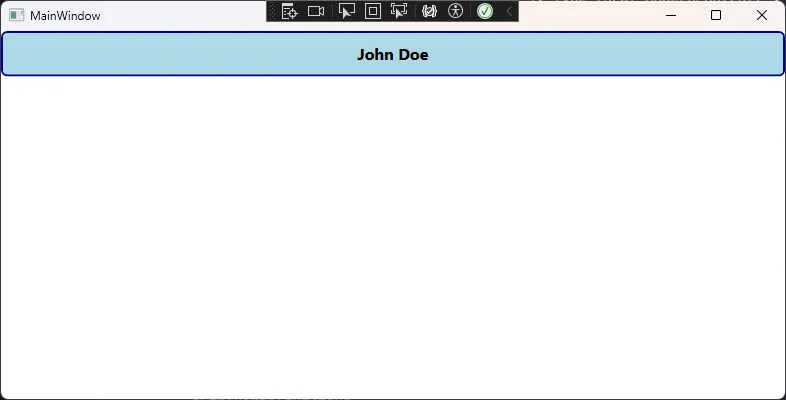
XML<Window x:Class="AppDependentPropertiesThan.MainWindow"
        xmlns="http://schemas.microsoft.com/winfx/2006/xaml/presentation"
        xmlns:x="http://schemas.microsoft.com/winfx/2006/xaml"
        xmlns:d="http://schemas.microsoft.com/expression/blend/2008"
        xmlns:mc="http://schemas.openxmlformats.org/markup-compatibility/2006"
        xmlns:local="clr-namespace:AppDependentPropertiesThan"
        mc:Ignorable="d"
        Title="MainWindow" Height="450" Width="800">
    <Window.Resources>
        <Style TargetType="{x:Type local:ModernControl}">
            <Setter Property="Template">
                <Setter.Value>
                    <ControlTemplate TargetType="{x:Type local:ModernControl}">
                        <Border Background="LightBlue"
                        BorderBrush="DarkBlue"
                        BorderThickness="2"
                        CornerRadius="5"
                        Padding="10">
                            <TextBlock Text="{TemplateBinding Title}"
                               FontSize="16"
                               FontWeight="Bold"
                               HorizontalAlignment="Center"
                               VerticalAlignment="Center"/>
                        </Border>
                    </ControlTemplate>
                </Setter.Value>
            </Setter>
        </Style>
    </Window.Resources>
    <Grid>
        <Grid.RowDefinitions>
            <RowDefinition Height="Auto"></RowDefinition>
            <RowDefinition Height="Auto"></RowDefinition>
        </Grid.RowDefinitions>
        <local:ModernControl Title="{Binding Name}" Grid.Row="0" />
    </Grid>
</Window>
🎨 3. 样式和模板支持
依赖属性的样式支持:
XML<Style TargetType="{x:Type local:ModernControl}">
    <Setter Property="Template">
        <Setter.Value>
            <ControlTemplate TargetType="{x:Type local:ModernControl}">
                <Border Background="LightBlue"
                BorderBrush="DarkBlue"
                BorderThickness="2"
                CornerRadius="5"
                Padding="10">
                    <TextBlock Text="{TemplateBinding Title}"
                       FontSize="16"
                       FontWeight="Bold"
                       HorizontalAlignment="Center"
                       VerticalAlignment="Center"/>
                </Border>
            </ControlTemplate>
        </Setter.Value>
    </Setter>
</Style>
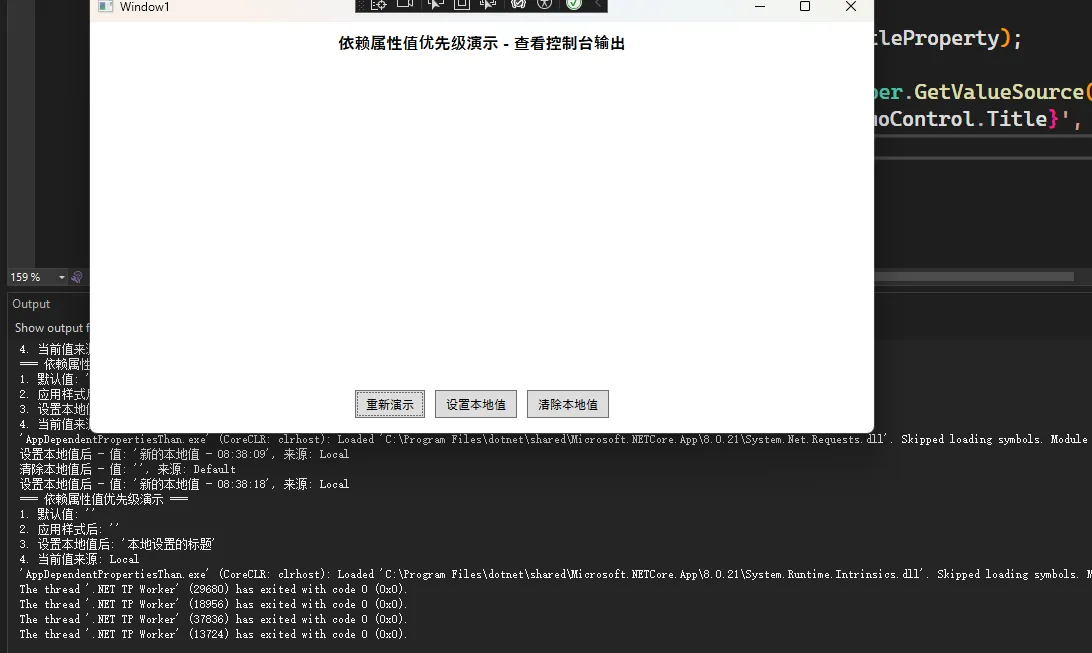
值优先级演示:
C#using System;
using System.Collections.Generic;
using System.Diagnostics;
using System.Linq;
using System.Text;
using System.Threading.Tasks;
using System.Windows;
using System.Windows.Controls;
using System.Windows.Data;
using System.Windows.Documents;
using System.Windows.Input;
using System.Windows.Media;
using System.Windows.Media.Imaging;
using System.Windows.Shapes;

namespace AppDependentPropertiesThan
{
    /// <summary>
    /// Interaction logic for Window1.xaml
    /// </summary>
    public partial class Window1 : Window
    {
        private ModernControl demoControl;
        public Window1()
        {
            InitializeComponent();

            StartValuePriorityDemo();
        }

        private void StartValuePriorityDemo()
        {
            Debug.WriteLine("=== 依赖属性值优先级演示 ===");

            // 清除之前的控件
            ControlContainer.Children.Clear();

            // 创建新的控件实例
            demoControl = new ModernControl();
            ControlContainer.Children.Add(demoControl);

            // 1. 默认值(优先级最低)
            Debug.WriteLine($"1. 默认值: '{demoControl.Title}'");

            // 等待一下,让UI更新
            Dispatcher.BeginInvoke(new Action(() =>
            {
                // 2. 应用样式后的值
                Debug.WriteLine($"2. 应用样式后: '{demoControl.Title}'");

                // 3. 设置本地值(优先级最高)
                demoControl.Title = "本地设置的标题";
                Debug.WriteLine($"3. 设置本地值后: '{demoControl.Title}'");

                // 4. 检查值的来源
                var valueSource = DependencyPropertyHelper.GetValueSource(demoControl, ModernControl.TitleProperty);
                Debug.WriteLine($"4. 当前值来源: {valueSource.BaseValueSource}");

            }), System.Windows.Threading.DispatcherPriority.Loaded);
        }

        private void RestartDemo_Click(object sender, RoutedEventArgs e)
        {
            StartValuePriorityDemo();
        }

        private void SetLocalValue_Click(object sender, RoutedEventArgs e)
        {
            if (demoControl != null)
            {
                demoControl.Title = $"新的本地值 - {DateTime.Now:HH:mm:ss}";

                var valueSource = DependencyPropertyHelper.GetValueSource(demoControl, ModernControl.TitleProperty);
                Debug.WriteLine($"设置本地值后 - 值: '{demoControl.Title}', 来源: {valueSource.BaseValueSource}");
            }
        }

        private void ClearLocalValue_Click(object sender, RoutedEventArgs e)
        {
            if (demoControl != null)
            {
                // 清除本地值
                demoControl.ClearValue(ModernControl.TitleProperty);

                var valueSource = DependencyPropertyHelper.GetValueSource(demoControl, ModernControl.TitleProperty);
                Debug.WriteLine($"清除本地值后 - 值: '{demoControl.Title}', 来源: {valueSource.BaseValueSource}");
            }
        }
    }
}
⚡ 4. 内存优化机制
传统属性的内存使用:
C#public class TraditionalButton : Control
{
    // 每个实例都会分配这些字段的内存
    private string _text;
    private Brush _background;
    private double _fontSize;
    private FontWeight _fontWeight;
    // ... 更多属性字段

    // 即使使用默认值,内存依然被占用
}
依赖属性的稀疏存储:
C#public class OptimizedButton : Control
{
    // 只有静态的依赖属性标识符
    public static readonly DependencyProperty TextProperty = ...;
    public static readonly DependencyProperty BackgroundProperty = ...;

    // 实际值存储在DependencyObject的内部字典中
    // 只有被显式设置的属性才占用内存

    public void DemonstrateMemoryOptimization()
    {
        var button1 = new OptimizedButton();
        var button2 = new OptimizedButton();

        // button1和button2共享默认值,不占用额外内存
        // 只有当设置了不同的值时,才会分配存储空间
        button1.SetValue(TextProperty, "点击我");
        // 现在button1才为Text属性分配了内存
    }
}
🛠️ 实战应用场景
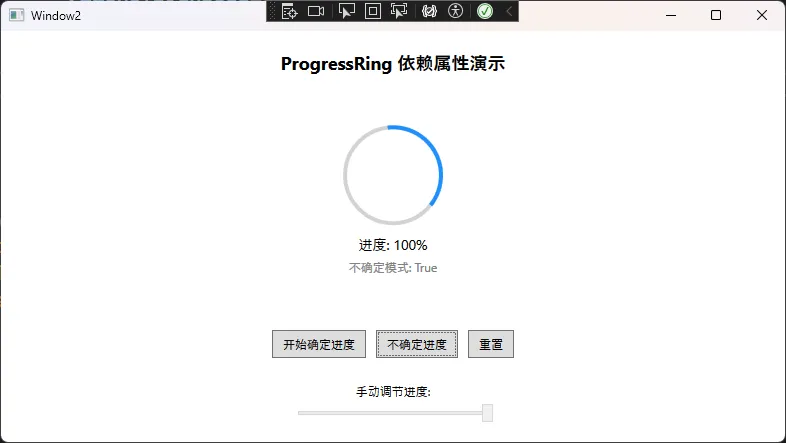
🎯 场景1:自定义控件开发
C#public class ProgressRing : Control
{
    static ProgressRing()
    {
        DefaultStyleKeyProperty.OverrideMetadata(
            typeof(ProgressRing),
            new FrameworkPropertyMetadata(typeof(ProgressRing)));
    }

    #region 依赖属性定义

    // Progress属性 - 支持动画
    public static readonly DependencyProperty ProgressProperty =
        DependencyProperty.Register(
            nameof(Progress),
            typeof(double),
            typeof(ProgressRing),
            new PropertyMetadata(0.0, OnProgressChanged, CoerceProgress));

    public double Progress
    {
        get { return (double)GetValue(ProgressProperty); }
        set { SetValue(ProgressProperty, value); }
    }

    private static object CoerceProgress(DependencyObject d, object value)
    {
        double progress = (double)value;
        return Math.Max(0, Math.Min(100, progress)); // 限制在0-100之间
    }

    private static void OnProgressChanged(DependencyObject d,
        DependencyPropertyChangedEventArgs e)
    {
        var ring = (ProgressRing)d;
        ring.UpdateVisualState();
    }

    // IsIndeterminate属性 - 控制是否显示不确定进度
    public static readonly DependencyProperty IsIndeterminateProperty =
        DependencyProperty.Register(
            nameof(IsIndeterminate),
            typeof(bool),
            typeof(ProgressRing),
            new PropertyMetadata(false, OnIsIndeterminateChanged));

    public bool IsIndeterminate
    {
        get { return (bool)GetValue(IsIndeterminateProperty); }
        set { SetValue(IsIndeterminateProperty, value); }
    }

    private static void OnIsIndeterminateChanged(DependencyObject d,
        DependencyPropertyChangedEventArgs e)
    {
        var ring = (ProgressRing)d;
        ring.UpdateVisualState();
    }

    #endregion

    private void UpdateVisualState()
    {
        if (IsIndeterminate)
        {
            VisualStateManager.GoToState(this, "Indeterminate", true);
        }
        else
        {
            VisualStateManager.GoToState(this, "Determinate", true);
            // 更新进度显示
        }
    }
}
XAML使用:
XML<local:ProgressRing Progress="{Binding LoadingProgress}"
                   IsIndeterminate="{Binding IsLoading}" />
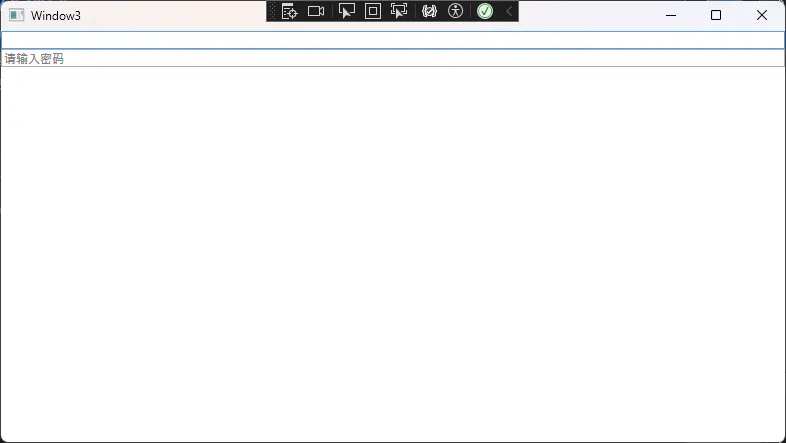
🔄 场景2:附加属性实现
C#public static class TextHelper
{
    // 附加属性:为任意控件添加水印功能
    public static readonly DependencyProperty WatermarkProperty =
        DependencyProperty.RegisterAttached(
            "Watermark",
            typeof(string),
            typeof(TextHelper),
            new PropertyMetadata(null, OnWatermarkChanged));

    public static string GetWatermark(DependencyObject obj)
    {
        return (string)obj.GetValue(WatermarkProperty);
    }

    public static void SetWatermark(DependencyObject obj, string value)
    {
        obj.SetValue(WatermarkProperty, value);
    }

    private static void OnWatermarkChanged(DependencyObject d,
        DependencyPropertyChangedEventArgs e)
    {
        if (d is TextBox textBox)
        {
            if (e.NewValue != null)
            {
                textBox.GotFocus += OnTextBoxGotFocus;
                textBox.LostFocus += OnTextBoxLostFocus;
                UpdateWatermark(textBox);
            }
            else
            {
                textBox.GotFocus -= OnTextBoxGotFocus;
                textBox.LostFocus -= OnTextBoxLostFocus;
            }
        }
    }

    private static void OnTextBoxGotFocus(object sender, RoutedEventArgs e)
    {
        UpdateWatermark((TextBox)sender);
    }

    private static void OnTextBoxLostFocus(object sender, RoutedEventArgs e)
    {
        UpdateWatermark((TextBox)sender);
    }

    private static void UpdateWatermark(TextBox textBox)
    {
        var watermark = GetWatermark(textBox);
        if (string.IsNullOrEmpty(textBox.Text) && !textBox.IsFocused)
        {
            textBox.Text = watermark;
            textBox.Foreground = Brushes.Gray;
        }
        else if (textBox.Text == watermark && textBox.IsFocused)
        {
            textBox.Text = string.Empty;
            textBox.Foreground = Brushes.Black;
        }
    }
}
XAML使用:
XML<TextBox local:TextHelper.Watermark="请输入用户名" />
<TextBox local:TextHelper.Watermark="请输入密码" />
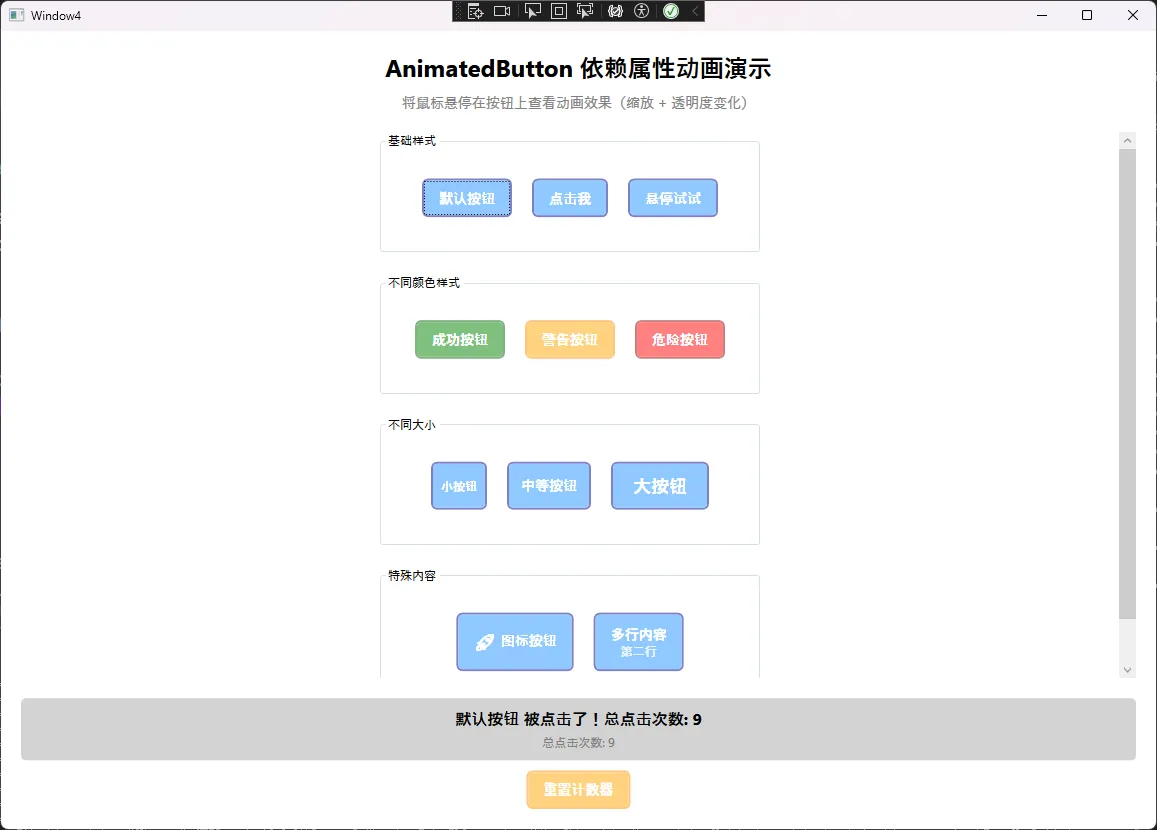
🎭 场景3:动画和数据绑定结合
C#public class AnimatedButton : Button
{
    // 支持动画的自定义属性
    public static readonly DependencyProperty AnimationProgressProperty =
        DependencyProperty.Register(
            nameof(AnimationProgress),
            typeof(double),
            typeof(AnimatedButton),
            new PropertyMetadata(0.0, OnAnimationProgressChanged));

    public double AnimationProgress
    {
        get { return (double)GetValue(AnimationProgressProperty); }
        set { SetValue(AnimationProgressProperty, value); }
    }

    private static void OnAnimationProgressChanged(DependencyObject d,
        DependencyPropertyChangedEventArgs e)
    {
        var button = (AnimatedButton)d;
        // 根据进度更新按钮外观
        button.UpdateAppearance((double)e.NewValue);
    }

    private void UpdateAppearance(double progress)
    {
        // 根据动画进度调整按钮外观
        var transform = new ScaleTransform(1 + progress * 0.1, 1 + progress * 0.1);
        this.RenderTransform = transform;

        var opacity = 0.5 + progress * 0.5;
        this.Opacity = opacity;
    }

    protected override void OnMouseEnter(MouseEventArgs e)
    {
        base.OnMouseEnter(e);

        // 创建动画
        var animation = new DoubleAnimation
        {
            From = 0,
            To = 1,
            Duration = TimeSpan.FromMilliseconds(200),
            EasingFunction = new QuadraticEase()
        };

        this.BeginAnimation(AnimationProgressProperty, animation);
    }

    protected override void OnMouseLeave(MouseEventArgs e)
    {
        base.OnMouseLeave(e);

        var animation = new DoubleAnimation
        {
            From = 1,
            To = 0,
            Duration = TimeSpan.FromMilliseconds(200),
            EasingFunction = new QuadraticEase()
        };

        this.BeginAnimation(AnimationProgressProperty, animation);
    }
}
⚠️ 常见坑点提醒
🚨 1. CLR包装器的局限性
C#// ❌ 错误:在CLR包装器中添加额外逻辑
public string BadTitle
{
    get { return (string)GetValue(TitleProperty); }
    set
    {
        // 这里的验证逻辑在XAML绑定时会被绕过!
        if (string.IsNullOrEmpty(value))
            throw new ArgumentException("Title cannot be empty");

        SetValue(TitleProperty, value);
    }
}

// ✅ 正确:在依赖属性的回调中处理逻辑
public static readonly DependencyProperty GoodTitleProperty =
    DependencyProperty.Register(
        nameof(GoodTitle),
        typeof(string),
        typeof(MyControl),
        new PropertyMetadata(string.Empty, null, CoerceTitle));

private static object CoerceTitle(DependencyObject d, object value)
{
    // 这里的逻辑不会被绕过
    if (value == null || string.IsNullOrEmpty(value.ToString()))
        return "默认标题";
    return value;
}
🚨 2. 性能陷阱
C#// ❌ 错误:频繁调用GetValue/SetValue
private void BadPerformanceMethod()
{
    for (int i = 0; i < 10000; i++)
    {
        // 每次都要通过依赖属性系统查找
        var title = (string)GetValue(TitleProperty);
        SetValue(TitleProperty, title + i);
    }
}

// ✅ 正确:合理使用本地缓存
private void GoodPerformanceMethod()
{
    var originalTitle = (string)GetValue(TitleProperty);
    var newTitle = originalTitle;

    for (int i = 0; i < 10000; i++)
    {
        newTitle += i;
    }

    // 只在最后设置一次
    SetValue(TitleProperty, newTitle);
}
🚨 3. 内存泄漏风险
C#// ❌ 错误:事件处理器可能造成内存泄漏
private static void OnBadPropertyChanged(DependencyObject d,
    DependencyPropertyChangedEventArgs e)
{
    var control = (MyControl)d;
    // 如果这里订阅了外部事件,需要在控件销毁时取消订阅
    SomeStaticEvent += control.HandleEvent;
}

// ✅ 正确:实现适当的清理机制
protected override void OnUnloaded(RoutedEventArgs e)
{
    base.OnUnloaded(e);
    // 清理事件订阅
    SomeStaticEvent -= HandleEvent;
}
🎯 总结核心要点
通过深入分析WPF依赖属性系统,我们发现了三个关键优势:
- 🚀 强大的绑定能力:依赖属性天生支持数据绑定、样式设置和动画,让WPF应用具备了强大的UI响应能力,这是传统CLR属性无法比拟的。
- ⚡ 优化的内存管理:通过稀疏存储和值优先级系统,依赖属性能够显著减少内存占用,特别是在创建大量控件实例时,性能优势更加明显。
- 🎨 丰富的扩展机制:元数据系统提供的回调函数、值强制转换和验证机制,让属性具备了强大的扩展能力,是构建复杂WPF应用的基石。
掌握依赖属性不仅能解决数据绑定问题,更能让你的WPF开发更加高效、优雅。记住:选择依赖属性用于UI相关功能,选择传统属性用于纯业务逻辑,这是WPF开发的黄金法则。
💭 互动讨论
- 你在项目中遇到过哪些依赖属性的使用难题?
- 有没有发现依赖属性的其他实用技巧想要分享?
🔥 收藏级代码模板已为你整理好,建议保存备用!觉得有用请转发给更多同行,让我们一起提升WPF开发技能!
本文作者:技术老小子
本文链接:
版权声明:本博客所有文章除特别声明外,均采用 BY-NC-SA 许可协议。转载请注明出处!
目录